2 The PCSL Competitor Rating (PCR): A Competitor’s Guide
Version 1.0, dated 2026-07-17.
2.1 Overview
The PCSL Competitor Rating, or PCR, is a measure of demonstrated skill expressed as a single number. It is computed from the results of sanctioned PCSL matches and reflects how a competitor has performed against the fields they have actually faced. Every competitor starts from a rating of 1500, and the number moves up or down from there as matches are rated.
This document is a simplified description of how the rating system behaves. It is not a statement of the exact computation, and it does not publish the formulas or values the system uses internally.
A rating is not a ranking of finishing positions, and it is not a points or class system. It does not award a fixed number of points for winning a match. Instead, it measures how a competitor’s performance compared with the specific field they faced, and how strong that field was. Two competitors who both won their respective matches can move very differently, because the fields they beat were different.
2.2 Rating categories
PCR is calculated separately for four categories: Pistol, PCC, Rifle, and 2-Gun. A competitor holds an independent rating in each category they have competed in. A competitor who shoots both Pistol and 2-Gun matches therefore carries two separate PCR numbers, one for each, and the two never mix. A strong rating in one category neither helps nor hinders a rating in another.
PCSL classifies each match as a Pistol, Rifle, or 2-Gun match, and results from that match feed the category named after the match’s type. There is one exception. Pistol Caliber Carbine (PCC) results are shot within Pistol matches, but they feed the separate PCC rating rather than the Pistol rating, because running a pistol-caliber carbine is treated as a distinct skill from running a pistol. A competitor who enters both the pistol and PCC portions of an event is building two different ratings from the one event.
Only the divisions PCSL tracks for rating purposes contribute to a rating. Results shot in other divisions are recorded in full but do not move any PCR number.
2.3 Performance and expectation
Every rating change comes from a single comparison: how a competitor actually performed against the field, set against what the ratings of that field predicted.
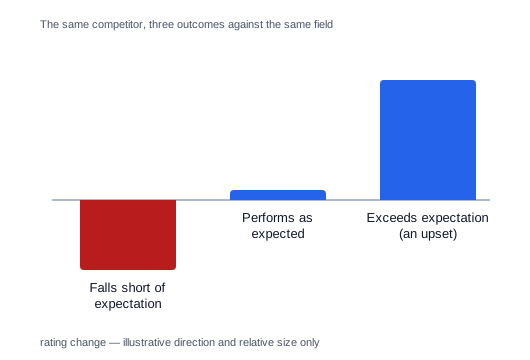
The ratings carried into a match supply an expectation: a higher-rated competitor is expected to out-perform a lower-rated one. When a competitor does better than that expectation, their rating rises. When they fall short of it, their rating falls. When they perform about as their rating predicted, the number moves very little. Two consequences follow. A heavy favorite who beats a weaker field by roughly the expected margin gains little, because the outcome matched what the ratings already expected. An upset, in which a lower-rated competitor beats a much higher-rated one, moves both ratings noticeably, because the result departed sharply from what was expected. Figure 1 illustrates the contrast.
A competitor’s first rating in a category receives particular handling. When a debut takes place against a field that already holds established ratings, the first rating is set cautiously, so that a single exceptional or poor first match does not produce an extreme number. When a field consists almost entirely of newcomers, competitors are instead rated from the 1500 starting point directly. In either case, a rating settles toward its level as further matches are rated.
2.4 Field strength
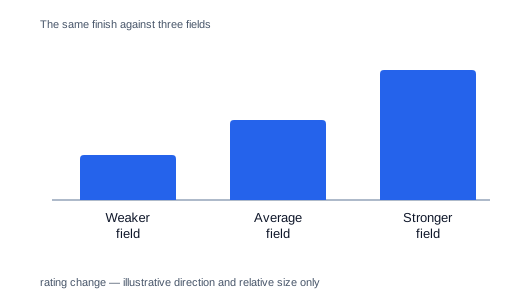
The strength of the field a competitor faces is part of what a rating means. The same finishing result moves a rating more when it is earned against a stronger field, and less when it is earned against a weaker one. Beating competitors who are themselves highly rated is worth more than beating competitors who are not, and the system accounts for this automatically. A rating is therefore earned against the competitors who were actually present, not against an abstract standard. Figure 2 shows how the same finishing result produces a different rating move against a weak, an average, and a strong field.
2.5 Match level
Not every match carries the same weight. Higher-level PCSL matches, the larger and more significant events, move ratings more than local matches do. The same performance counts for more at a major than at a club match. This reflects the greater stakes and typically stronger, deeper fields at higher-level events, and it means that results earned at the most significant matches have the largest influence on where a rating settles.
2.6 Ongoing recalculation
Ratings are kept current automatically. A competitor does not have to wait for a manual rebuild to see a new match reflected in their rating, and the league does not have to repair ratings by hand after a match is corrected.
As sanctioned results are ingested, and on the occasions when a match must be corrected or reclassified to a different match type, the system recomputes the ratings that those results affect. Because a correction can reach back into earlier history, a competitor’s rating in a category can change even when they have not recently competed in that category themselves, because an earlier match feeding that category’s results was corrected or reclassified. This reflects how the system keeps every rating consistent with the full body of results as that body changes. The recorded results of a match are themselves final once recorded; what the recalculation adjusts is the ratings computed from them, never the match scores. A competitor’s rating always reflects the complete, current record rather than an outdated view of it.
2.7 An illustrative scenario
Consider a competitor with a settled Pistol rating who is clearly stronger than the field at a local club match. She wins the match, roughly as her rating predicted she would. Because the result was expected and the match was a local one, her rating moves only slightly upward. The win confirms what her rating already said; it does not reveal anything new about her skill, so there is little for the system to add.
Some weeks later, the same competitor enters a major match against a much stronger field, including several competitors rated well above her. She is not expected to place near the top. Instead she turns in an exceptional performance and finishes ahead of several of those higher-rated competitors. This is an upset relative to expectation, it is earned against a strong field, and it happens at a high-level match, so all three factors push in the same direction. Her rating rises substantially, far more than it did from the club-match win, and the higher-rated competitors she beat see their own ratings fall.
This scenario illustrates that where and against whom a result is earned matters as much as the result itself. A comfortable win over a weak local field is worth little to a rating; an upset over a strong field at a major is worth a great deal.
2.8 Additional notes
Category independence. Pistol, PCC, Rifle, and 2-Gun ratings are computed and stored independently. A result in one category never touches a rating in another, and no rating is a blend of the others.
Inactivity. Inactivity never lowers a rating. A competitor who steps away keeps the rating they last earned, carried forward unchanged until they compete again. A rating moves only when a match is rated, never because time has passed.
Early ratings. A first rating is placed cautiously and can therefore start at some distance from a competitor’s true level; larger movements in the matches that follow are the rating closing that gap. Once a rating sits near a competitor’s true level, results tend to land where the rating predicts, and each match moves the number only a little. That steadiness comes from the rating matching the competitor’s skill, not from the number of matches behind it.
Finality of results. Recorded match results are final. The league does not edit scores in place. Ratings computed from those results are recalculated as the overall record changes, but the underlying match results are a permanent record.
Uniform application. Every competitor is rated by the identical system, from the same 1500 starting point, under the same rules. No rating is ever set or adjusted by hand.